Fire Alarm Servicing Under BS 5839-1:2025: What Changed
Under BS 5839-1:2025, a fire alarm system should be serviced by a competent person at intervals of approximately six months, and any visit between five and seven months after the previous one is acceptable. That tolerance is new: the 2017 edition said the gap should not exceed six months, full stop. It is one of several changes in the 2025 revision that land on the service visit itself, from checking the panel clock to calculating a false alarm rate. This guide covers what changed for fire alarm servicing, and what it means for the way you run maintenance contracts.
Is fire alarm servicing a legal requirement?
The duty is in law; the detail is in the standard. In England and Wales, the Regulatory Reform (Fire Safety) Order 2005 requires the responsible person to keep fire safety equipment subject to a suitable system of maintenance, in efficient working order and in good repair. Scotland and Northern Ireland have equivalent duties.
BS 5839-1 is the code of practice that says what "suitable maintenance" looks like for fire detection and alarm systems in non-domestic premises. It is a set of recommendations rather than law, but it is what fire risk assessors, enforcing authorities, insurers and certification schemes measure a system against. In practice, a system that isn't serviced to BS 5839-1 is very hard to defend.
How often should a fire alarm be serviced under BS 5839-1:2025?
The interval itself hasn't changed. What changed is how strictly it is read:
| | BS 5839-1:2017 | BS 5839-1:2025 | |---|---|---| | Service interval | Should not exceed six months | Approximately six months | | Tolerance | None: a late visit meant the system was no longer compliant | Any time between five and seven months after the previous visit is acceptable | | Starting point | Not stated as a datum | The date of acceptance (handover) is the datum for the periods | | Who carries it out | A competent person | A competent person, now defined in line with BS 4422:2024, with CPD noted as part of maintaining competence |
The FIA's guidance on the revision describes this as bringing the standard into line with custom and practice: servicing within the month before, or the month after, the visit falls due. It doesn't make the cycle longer. Plan visits on a six-month cycle counted from handover, and treat the month either side as tolerance, not a new target.
The user's own routine checks are unchanged. The weekly test of a manual call point and the logbook entries that go with it remain the premises' job, not yours.
What should every service visit now include?
The core of the inspection and test is familiar. The 2025 revision adds or sharpens several items for every visit:
- Check the panel clock. Any time clock in the control and indicating equipment (CIE) should be checked and adjusted. This matters most where the system has day/night settings.
- Confirm every signal to the ARC. Where the system signals to an alarm receiving centre, the alarm signals sent to the ARC should be checked, and where more than one type can be sent (fire and fault, for example), the correct transmission of each should be confirmed.
- Keep disablements to a minimum. Where servicing disables protection in significant parts of the system, or disables sounders or visual alarms, keep it to a practicable minimum and tell the premises management which areas are affected.
- Calculate the false alarm rate. The trigger points for investigating false alarms now line up with a false alarm calculation recommended at each service visit (more on this below).
One related change sits under repair arrangements rather than the visit itself: where the user reports a fault and you can't repair it effectively, the fault indication shouldn't be concealed, for example by suppressing it at the panel.
What's added at the 12-monthly visit?
Some checks only need doing once a year, and the 2025 revision adds to that list:
- Remote indicators should be checked for correct operation, so they haven't been obstructed or painted over. The standard also clarifies that their visual indication should be red.
- Smoke detectors in ventilation ducts now get a functional test.
- Zone identification shown on the CIE should be verified: the zone reported is the zone that was tested, and it matches the zone plan.
Checking every text descriptor on an addressable system is not a routine service task. Keeping them accurate is the premises management's responsibility, and they should tell you about changes. The FIA suggests it might be prudent to confirm them periodically, for example every five years.
How do you calculate the false alarm rate?
The 2025 revision adds a new Annex F that sets out the calculation:
False alarm rate = 100 × (number of false alarms ÷ number of automatic fire detectors)
Count the false alarms over the previous 12 months. The trigger points haven't changed, but they are now expressed against this rate:
| Rate over the last 12 months | What's recommended | |---|---| | More than 4 false alarms per 100 detectors | A preliminary investigation | | More than 5 false alarms per 100 detectors, on a system with more than 40 automatic detectors | An in-depth investigation |
A worked example: a system with 150 automatic detectors had 7 false alarms in the last year. That is 100 × 7 ÷ 150 = 4.7 per 100 detectors, so a preliminary investigation is due, but not yet an in-depth one.
The revision also says every false alarm should be investigated by the user, and that the commissioning or handover organisation should explain how to do this and the categories of false alarm, so each incident is recorded under the right one. Where point smoke detectors present a higher risk of false alarms, the 2025 revision recommends multi-sensor detectors instead.
What changed for modifications and firmware?
Two changes affect work you might previously have treated as routine:
- Firmware updates are modifications. The 2025 revision clarifies that updating the firmware of a CIE is a modification, and a certificate is required. The certificate itself is now an extension or modification certificate, in a new Section 7 of the standard.
- Redundant devices go, or are labelled. Where a modification leaves existing equipment out of use, the redundant devices should be removed where practicable, or clearly identified as no longer in use.
The new section also accepts a reality of extension work: the new work should comply with the current standard, even if the overall system it joins does not.
What changed for variations and the logbook?
Under the 2017 edition, only "major" variations had to be recorded, and "major" was never defined. Now all agreed variations should be recorded in the system logbook, and all variations need justification, especially those proposed at installation or commissioning.
Some departures are no longer acceptable as variations at all:
- No zone plan (or equivalent diagram) in premises with more than one zone on any storey, particularly where people sleep.
- No facility to transmit fire alarm signals to an ARC in a residential care home, or in supported housing where one is needed to meet BS 5839-1.
If you inherit a system with either of these written down as an agreed variation, it's worth raising with the client at the next visit.
Do existing systems need upgrading?
Mostly, no. The headline design change is that heat detectors are no longer permitted in rooms where people sleep in Category L2 systems, and shouldn't be used there in L3 systems either. Sleeping rooms are now treated as high-risk rooms needing earlier warning. Stairway lobbies, previously excludable as low risk, now need automatic detection too.
These recommendations are not retrospective. An existing system doesn't need changing unless it undergoes new works, such as a system upgrade. That makes them a quoting matter rather than a servicing one: when you price an upgrade or extension, the sleeping-room and stairway-lobby recommendations apply to the new work.
What changed for alarm transmission to the ARC?
With the PSTN switch-off due in 2027 and alarm signalling moving to IP, BS 5839-1:2025 sets maximum times for signals to reach the ARC: 90 seconds for a fire alarm signal from a Category L system, and 120 seconds from a Category P system. A catastrophic failure of the transmission path on a Category L system should be indicated at the ARC and the CIE within 3 minutes.
There is also a new clause on remote servicing and cyber security. Connected panels should be protected from unauthorised access by physical means, such as a locked comms cabinet or anti-tamper plugs, and a remote connection should be authenticated before it is accepted. A risk assessment should be carried out before any remote service, particularly when reading, controlling or writing to the panel. Where there's any risk the remote service could affect the CIE, the responsible person must make sure the system is fully operational when the session ends.
To cut false alarm call-outs, the revision also recommends a false alarm notice at or next to the CIE. It reminds whoever tests the system that it has an active connection to the fire and rescue service via an ARC, and gives the ARC's phone number.
How Opscel handles fire alarm servicing
Opscel's fire alarm certificates are built on BS 5839-1:2025, so the visit and the paperwork follow the same standard:
- The service certificate asks for the 2025 checks. The Fire Alarm System Service Certificate has fields for the control panel clock check, the ARC signal transmission test, false alarms since the last visit, the false alarm rate per 100 detectors, and variations from the standard. The site's ARC details pre-fill from the site record.
- Six-monthly visits are planned for you. A service contract set to every 6 months creates the next visit as a draft job a set number of days ahead of its due date (14 by default), and shows how many days until it's due or how many days overdue it is.
- Modifications get their own certificate. Extensions and modifications are certified on a separate Fire Alarm Modification Certificate.
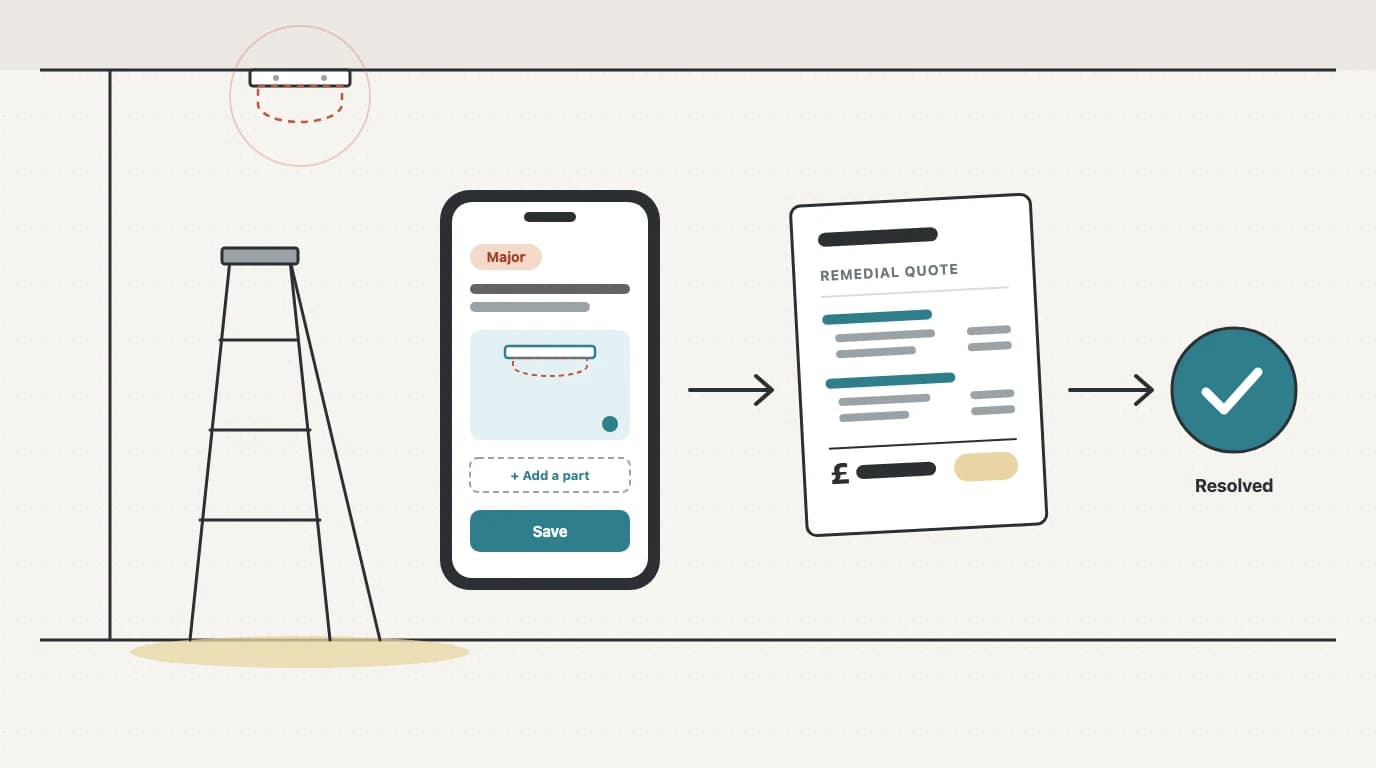
- Faults become remedial quotes. Defects logged on a service job can be bundled into a single remedial quote. Our guide to going from defect to remedial quote walks through the workflow.
TL;DR
| Question | Short answer | |---|---| | How often should a fire alarm be serviced? | Approximately every six months, by a competent person | | How late can a service be? | Any time between five and seven months after the previous one is acceptable | | What's new at every visit? | Check the panel clock, confirm each ARC signal, keep disablements minimal, calculate the false alarm rate | | What's the false alarm trigger? | Over 4 per 100 detectors a year: preliminary investigation. Over 5, on systems with more than 40 detectors: in-depth | | Is a firmware update a modification? | Yes, and it needs an extension or modification certificate | | Which variations go in the logbook? | All of them, not just "major" ones | | Must existing systems lose heat detectors in bedrooms? | No, the change isn't retrospective. It applies when the system has new works |
This guide summarises the changes as set out in the Fire Industry Association's guide to BS 5839-1:2025. Always work to the standard itself.
Want to see how Opscel handles this?
Book a 15-minute demo and we'll walk through it live.
Explore Service ContractsKeep reading
The RAMS Approval Process: A Guide for UK Contractors
The RAMS approval process for UK fire and electrical contractors: what the law asks, what clients ask, version control, engineer sign-off and approval.
EIC vs EICR vs Minor Works: Which Certificate Do You Need?
EIC, EICR or Minor Works? Which electrical certificate to issue for new circuits, consumer unit changes, additions and periodic inspections, job by job.
From Defect to Remedial Quote: A Workflow for Fire Alarm Contractors
Faults found on a service visit are remedial work waiting to be quoted. A practical workflow for fire alarm contractors: capture defects properly on site, triage by severity, bundle them into one quote, and track each one to resolution.